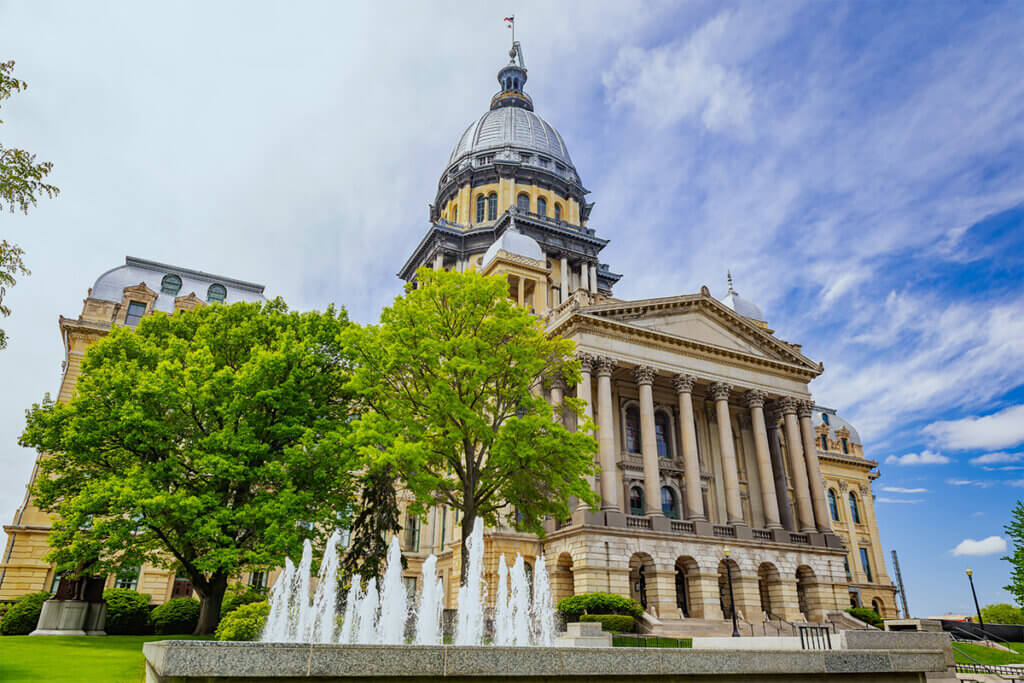
The spring session of the 104th General Assembly has come to a close, with a maintenance budget and several key policy changes. While much of the session was dominated by debates over revenue and higher education funding, the final outcomes represent an ongoing commitment, broadly, to education in an increasingly fiscally constrained environment.
Legislative Highlights
One of the most prominent, albeit controversial, pieces of passed legislation is SB2427, the in-school cell phone ban supported by Governor Pritzker. Districts will need to adopt and implement cell phone policies for the 2026–27 school year to prohibit student use of devices during instructional time and to guide device storage during the school day. Given the localized nature of these policies, we are eager to see how the impact is ultimately evaluated for Illinois learners to ensure it supports student engagement and outcomes.
As in several years previously, several legislators put forth proposals to update high school graduation requirements. Several sought to eliminate or modify the foreign language requirement (which would have affected students entering 9th grade in the 2028–29 school year). Other proposals included adding new requirements around computer science (HB4411) or financial literacy (HB5533). Ultimately, Senator Willie Preston’s SB3070 passed, which adds an exception to the foreign language requirement for students who complete two Career and Technical Education courses.
While proposals to redesign the higher education funding formula and community college baccalaureate degrees ultimately failed in this session, we anticipate advocates returning to those topics during the fall veto session.
Enacted Budget Highlights
The enacted state budget represents a maintenance budget, particularly given constraints on raising new revenue. State and local leaders are grappling with ongoing federal cuts, particularly to assistance programs that shape family resources, such as SNAP.
While Governor Pritzker initially proposed a $305 million addition to the Evidence-Based Funding formula for school districts, the enacted budget includes an additional $350 million, which is a welcome increase despite being far from what advocates pushed for to achieve full funding.
Another long-overdue increase in investment was for Mandated Categoricals (MCATs), which cover items such as free or reduced-price lunch and transportation. This will provide some relief to districts amid inflationary pressure. We are also heartened to see the maintenance of dual credit funding through the Illinois Community College Board, a critical support for developing and scaling quality dual credit policy and practice. The enacted budget also includes funding to support the Illinois State Board of Education (ISBE) in developing ways of measuring low-income status for students, given that narrowing federal eligibility rules for programs such as SNAP could result in undercounting lower-income students in Illinois schools.
Unfortunately, flat funding across important categories in education, including career and technical education (CTE) and the Monetary Award Program (MAP). Included is a minimal increase (1% year-over-year) for higher education. Together, those funds preserve important investments but fall short of meeting the field’s broader needs. Unfortunately, ISBE’s teacher vacancy grant program was reduced by $15 million, which will affect ISBE’s ability to scale important teacher pipeline interventions.
What’s Next?
As we look to Governor Pritzker signing these bills into law and our state leaders move forward with implementation and guidance, we are keeping a close eye on how districts, communities, and students will be supported in making sense of new expectations and realities.
In particular, we are continuing work alongside a representative advisory group to grapple more holistically with Illinois’ high school graduation requirements, particularly challenges and opportunities, and articulate shared policy values that will drive future conversations about what a high school diploma should mean in Illinois. Stay tuned as we release a survey in the coming weeks for high school leaders to inform our work!
Looking ahead to the veto session this fall, we will be closely monitoring efforts to alter the state’s higher education funding formula, as well as emerging work on re-entry for young people in the juvenile justice system (such as SB2863, which could provide new opportunities to engage a disconnected population in important pathways work). As new topics arise, we will share them both on our blog and with the Illinois Education and Career Success Network Policy Committee.