What if the biggest barrier to scaling work-based learning isn’t employer willingness but rather the systems around them?
The bridge between academic instruction and industry application remains a focal point for workforce development. While educational institutions are eager to place students in professional environments and employers are generally willing to help, the practical implementation of these programs can serve as an exercise in risk mitigation and talent pipeline management.
Recent insights from our Scaling Transformative Advanced Manufacturing Pathways (STAMP) employer implementation survey provide a look into the reality of work-based learning in action. The feedback from organizations shows strong employer engagement and growth, while indicating gaps in transportation, liability, and student readiness are holding back expansion.
Employer Participation by Type of Work-Based Learning
About the STAMP Employer Survey
Realities of Training Tomorrow’s Workforce
The Under 18 Barrier
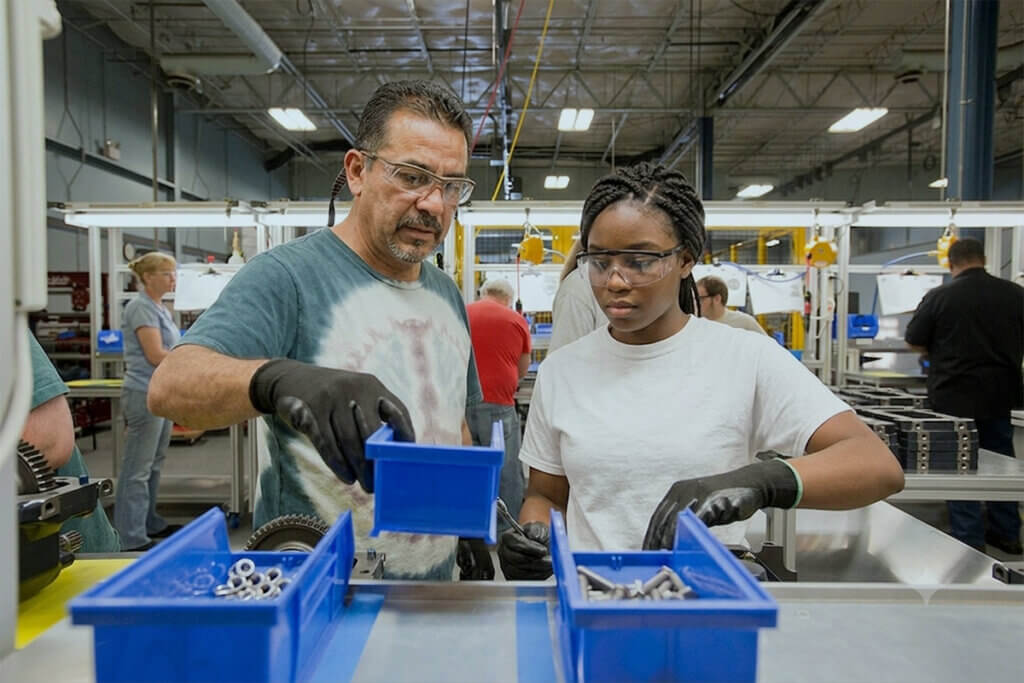
For many industries, particularly the skilled trades, the “insurance wall” is a primary pipeline hurdle. While significant work is underway to introduce younger students to manufacturing and technical roles, insurance and liability constraints often keep them “confined to office environments,” as noted by a survey participant. This creates a paradox: We want students to explore trades, but safety constraints often lock them out of the very shops where learning happens.
"It is impossible for us to employ anyone under 18 years old in any role because we can not insure them. I can get around this when working with some programs where the interns are employed and insured by the school."
— Survey participant
In the hierarchy of employer concerns, safety constraints and liability insurance represent distinct but related hurdles. Many are eager to teach high-level skills such as CNC repair, automation development, and programming, yet safety and age-related restrictions often confine high school students to office environments. Instead of gaining experience on the shop floor, students find themselves separated from the very equipment and technical workflows they need to master to enter the industry.
Prioritizing “Workforce Readiness”
One of the most striking findings in the data is that student readiness and student screening are prioritized as barriers to employer participation in work-based learning over budget or equipment limitations. In fact, these were consistently ranked as #1 or #2 in terms of impact on program success. Employers are signaling a shift in focus: They aren’t just looking for technical skills; they are looking for behavioral baseline expectations.
Industry feedback emphasizes that while a technical training partner can handle the mechanics of the trade, the classroom cannot always replicate typical workday behaviors.
One survey participant advocates for a systemic change, noting that workforce readiness needs to be “strongly emphasized” as early as junior high to be effective. Another echoed this, pointing out that students are challenged by the stamina or professional social cues required for a standard workday.
The surfaced message: Technical training is secondary to professional socialization.
Ranking of Employer Barriers to Work-Based Learning
Moving Beyond Supervision to Mentorship
- Onboarding documents: Utilizing formal employer handbooks to set professional standards immediately.
- Regular check-ins: Moving beyond oversight to scheduled feedback sessions.
- Portfolio development: Helping students build a library of work products that prove their competency.
- Pathway transparency: Proactively sharing postsecondary industry secrets and career routes.
"We consider the apprenticeship program a very important part of our business."
— Survey participant
A frequent misconception among policymakers is that the primary barrier to hosting interns or apprentices is the cost of wages. The survey data, however, indicate that the hurdle is more temporal than financial. When ranking obstacles, supervisor capacity and scheduling/timing were identified as more significant barriers than budget and wages.
For industry leaders, the survey suggests a broader trend: The true cost of an internship is not the intern’s paycheck, but the expert’s time. On a lean, busy shop floor, finding a budget for a student is often simpler than finding an experienced staff member with the bandwidth to provide consistent, high-quality instruction. Success in these programs depends less on financial capital and more on the availability of human capital to serve as mentors.
The Untapped Power of Industry Pathways
The survey reveals a notable implementation gap in how employers document the learning process. Sharing career and postsecondary pathways within the industry is a highly utilized practice, yet the development of professional portfolios is significantly lagging. This suggests that while employers are excellent at painting a vision of the future, they are less equipped to help students document their current progress.
There is an untapped opportunity for employers and schools to collaborate on creating a library of work products. By helping students catalog their daily tasks and competencies, industry partners can help them build a portable portfolio that proves their readiness to future employers and postsecondary institutions alike.
The Desire for Growth Despite the Hurdles
An important takeaway is measured, realistic expansion shaped by employer capacity. Across STAMP regions, partners expressed a desire to expand their work-based learning programs, even as they navigated constraints such as supervisor capacity, liability, and operational limitations. Most report that participation will stay the same or increase modestly, signaling steady commitment rather than rapid scale.
For many manufacturers, particularly small and mid-sized operations, growth is limited by the size of their shops, the availability of staff, and the nature of their hands-on work environments. This reality shows up clearly in employer responses:
- One employer already engages with large numbers of students through career fairs, but is only beginning to expand internships, noting growth will be incremental as capacity allows.
- Another hosts 1-2 apprentices at a time, along with 10 students from the D214 Life Program, which supports individualized student planning for career and life-ready needs.
- A third aims to increase placements from 2 to 4 students, another example of modest, intentional growth rather than large-scale expansion.
These examples reinforce a key insight: individual employers, especially in manufacturing, are unlikely to scale to serve dozens of students at once. Instead, sustainable growth will depend on broadening the employer partner networks alongside supporting those already engaged.
Expectations for Continued Employer Participation in Work-Based Learning
What Employers Say is Needed for Success
When employers rank what they need to succeed, having a faculty liaison consistently rises to the top. The most effective internships are a three-way street between the student, the employer, and a dedicated school contact who acts as a logistical lynchpin.
This liaison is responsible for navigating the red tape that otherwise fatigues employers. For instance, while one employer emphasizes that success “depends on the student’s true interest,” the logistical feasibility often comes down to school-side flexibility. Another employer noted that the ultimate success of long-term work-based learning often hinges on the school’s ability to coordinate block scheduling. Without a dedicated liaison to align school hours with business needs, programs can fail before they begin.
Current Work-Based Learning Scheduling
Frequency/Duration of Current Work-Based Learning
Understanding how work-based learning fits into the school day is critical for design. The dominant model is embedded and ongoing, not a one-time experience. This reinforces the need for system alignment between school schedules and employer operations.
What Should We Do Next?
Explore Transportation Solutions
Transportation remains one of the most significant barriers to equitable access to work-based learning. To address this, regional partners could explore coordinated transportation models that allow multiple districts to share resources and reduce costs. This could include pooling buses, aligning school schedules, or leveraging community-based transportation providers. Dedicated funding streams for student travel are also essential to ensure that participation in work-based learning is not limited by a student’s ability to reach a worksite.
Address Liability and Policy Barriers
Liability and insurance remain challenges to employer participation, particularly when working with students under 18. Streamlining insurance requirements and developing shared liability frameworks can reduce confusion and perceived risk for employers. In addition, clearer, more consistent policies at the state and regional levels, especially those related to youth employment and safety, can help employers feel more confident in expanding opportunities for students.
Strengthen Student Readiness Systems
Employers emphasized the importance of students entering work-based learning experiences with a baseline understanding of workplace expectations. This calls for earlier and more intentional integration of workforce readiness skills in middle and high school. Expanding pre-apprenticeship models and structured onboarding support can help bridge this gap, while aligning classroom expectations, such as punctuality, communication, and accountability, with workplace norms will better prepare students for success.
Build Employer-Friendly Infrastructure
To sustain employer engagement, systems must be easy to navigate and implement. Providing ready-to-use templates, such as training plans, onboarding documents, and evaluation tools, can reduce administrative burden. Ongoing technical assistance also helps employers translate program expectations into practice. Establishing consistent points of contact, such as liaisons who coordinate between schools and employers, can further streamline communication and strengthen partnerships.
Sustain and Scale Funding
Many current work-based learning opportunities are supported by short-term grant funding, creating uncertainty for employers and limiting long-term planning. To truly scale these efforts, partners must identify ways to transition from temporary funding sources to more permanent, sustainable structures. This includes aligning public and private investment to ensure that both education systems and employers have the resources needed to maintain and grow high-quality work-based learning programs.
Resources
Partners looking to strengthen implementation can draw on several existing tools and frameworks, including resources outlining Illinois’ technical and essential employability competencies, guidance on hosting high school interns, and criteria for scaling high-quality work-based learning. Additional tools, such as the Career Pathways Dictionary, can support shared language across education and industry partners, helping ensure that efforts to expand work-based learning are consistent, clear, and effective.
From Opportunity for Students to Infrastructure to Scale
Local industry confirms a desire to mentor the next generation. However, to evolve these programs, we must build a stronger bridge between technical training partners and high schools.
Addressing supervisors’ capacity and the limitations of safety regulations will require creative policy solutions, such as exploring block scheduling, as several participants suggested, to allow for deeper immersion. Industry partners are telling us that prioritizing workforce readiness and essential skills alongside technical skills will reduce the gap between the classroom and the shop floor.
Taken together, this data tells a compelling story for regional leaders, educators, and partners: We are past the awareness stage of work-based learning. We are now in the infrastructure stage.
In other words, the question is less likely to be “Do employers want to participate?” Now we are asking, “Do our systems make it possible for them to scale?” At EdSystems, our focus is on building systems that make work-based learning not just possible, but scalable, equitable, and sustainable.
Acknowledgements
This work is made possible by the Illinois Department of Commerce and Economic Opportunity and The Chicago Community Trust, whose investments have supported high-quality manufacturing pathways across Illinois. We also thank the Illinois Manufacturers’ Association, a co-organizer of STAMP, whose collaboration and partnership continue to advance the initiative.
Finally, we are grateful for the commitment of our STAMP regional teams and their employer partners, whose ongoing engagement, insights, and willingness to host students make this work possible. Their efforts are essential in building and sustaining meaningful work-based learning opportunities that connect students to careers.