
What happens to students after they walk across the stage at high school graduation? Do they enroll in college? Do they complete their degrees? Do they find good jobs that pay well?
These sound like simple questions, but in Illinois—and across much of the country—we don’t have clear, consistent answers. That’s a problem, because without this information, we can’t tell whether our education programs are actually working or which students are falling through the cracks.
Today, we’re releasing a new brief from Sr. Director of Data Ben Boer, “Linking Illinois High School to College Data and Beyond,” that explores why connecting education and workforce data is so challenging, why it matters, and what Illinois needs to do next.
The Data Gap We Can't Afford to Ignore
Right now, there’s no central source of data showing whether Illinois high school graduates are enrolling in college, persisting through their programs, and landing careers that support them financially. While the Illinois State Report Card publishes some postsecondary enrollment data, it’s limited—often backdated, restricted by privacy rules for smaller schools, and not broken down by race, ethnicity, or gender.
This means we can’t answer critical equity questions: Are students of color getting the same opportunities as their white peers? Are low-income students finding pathways to economic mobility? Are our career pathway programs—like manufacturing or IT initiatives—actually leading to good jobs?
At EdSystems, we work to create seamless transitions from high school through postsecondary education and into careers. We support pathway programs, dual credit courses, and transitional instruction designed to prepare every Illinois student for success. But when we can’t track outcomes across these transitions, we’re essentially flying blind.
Why Linking Data Is So Hard
The challenges aren’t just technical—they’re structural. Education and workforce data live in different systems, managed by different agencies, collected for entirely different purposes:
- K-12 data helps with attendance tracking, accountability, and program implementation
- Postsecondary data shows which programs students choose and whether they complete degrees
- Workforce data from the Illinois Department of Employment Security was designed to administer unemployment insurance, not track career outcomes
Why This Matters Now More Than Ever
Education is fundamentally about opportunity—preparing students to advance economically and lead productive lives. Without linked data, we can’t ensure that our education system is equitable or that all students can reach their full potential.
Consider our Scaling Transformative Advanced Manufacturing Pathways (STAMP) program, a partnership with the Illinois Manufacturers’ Association that helps Illinois high schools create manufacturing pathways leading to industry credentials and careers. To know if STAMP is working, we need to track whether participants enroll in community college, graduate, and find good manufacturing jobs. That requires linking program data to college records and employment outcomes—a process that currently involves negotiating separate agreements with multiple school districts and colleges, implementing rigorous privacy protections, and validating data quality at every step.
School districts, community colleges, and universities face similar challenges. They’re under pressure to prove their programs work, but few have the expertise or capacity to link data on their own. When local entities use different linking approaches than state agencies, it creates inconsistent results and undermines confidence in the data.
A Path Forward for Illinois
The good news? Illinois has made real progress over the past decade. Eight state agencies now use a common linking key, and recent legislation establishing an Early Childhood Integrated Data System shows what’s possible when we prioritize connected data.
The brief outlines specific recommendations to build on this momentum:
- Continue funding multi-agency data matching efforts that create the most reliable links across systems
- Support local data linking so school districts and colleges can measure their own program effectiveness
- Invest in data infrastructure across state agencies, including better employment records, enhanced coursework tracking, and streamlined data agreements
- Leverage national tools like the Postsecondary Employment Outcomes initiative and Coleridge Initiative to complement state efforts
- Make data analytics central to all education and workforce policy decisions
Perhaps most importantly, we need to build sustained capacity—including Chief Analytics and Chief Data Officers at agencies—to lead these efforts over the long term.
The Bottom Line
Every student who graduates from an Illinois high school deserves a clear pathway to economic opportunity. To ensure we’re creating those pathways equitably and effectively, we need to see the full picture—from high school through college and into careers.Linking education and workforce data isn’t just a technical challenge. It’s an equity imperative and an investment in Illinois’s future.
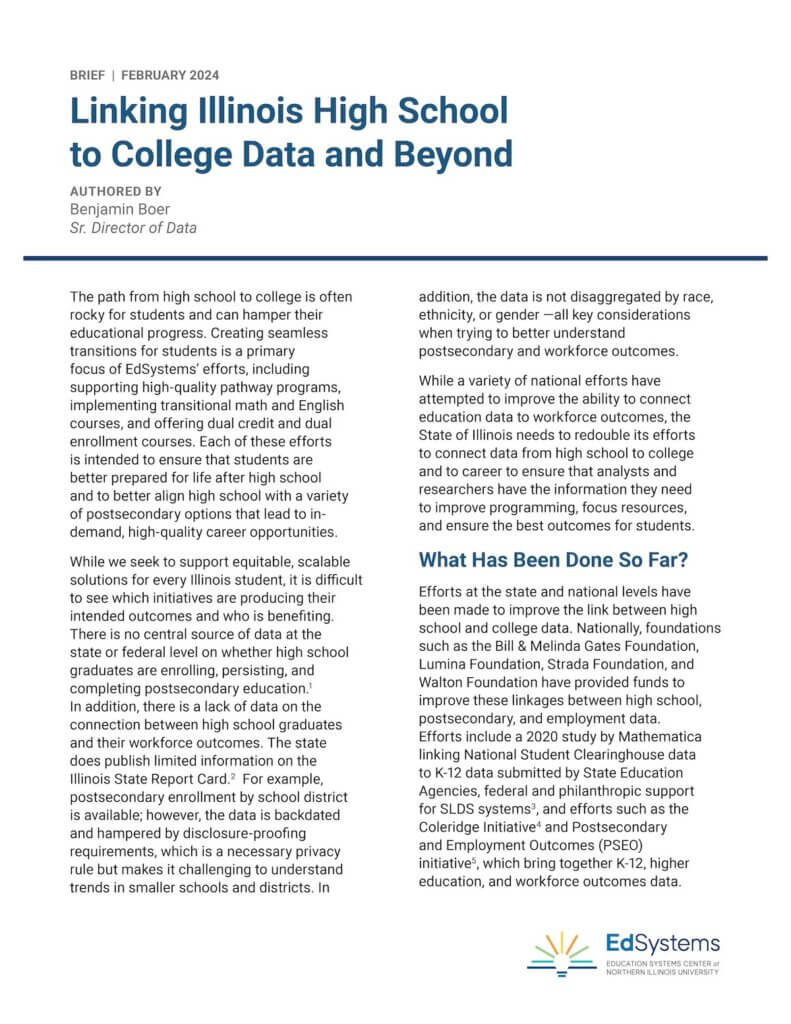
Linking Illinois High School to College Data and Beyond
Read the full brief to learn more about the challenges, opportunities, and specific steps Illinois can take to connect the dots between education and employment.