
For the past quarter-century, the drive to use data more effectively has been central to improving education. Despite this, the approach to data is still frequently driven by a top-down mentality focused on compliance and accountability. While this informs high-level policy, it fails to support the year-to-year and month-to-month decisions that local school and college administrators need to make.
This challenge is particularly acute in understanding the high school-to-college transition, where datasets on course-taking, grades, and attendance are highly complex. Furthermore, the ultimate endpoint for high school success is not merely more schooling, but long-term employment with a livable wage—an outcome driven by a multitude of factors far beyond a single degree or credential.
To move communities away from a punitive accountability mindset and toward a vibrant culture of continuous program improvement, EdSystems has launched a refined approach: Regional Data Collaboratives.
Connecting the Data Engine to the Chassis
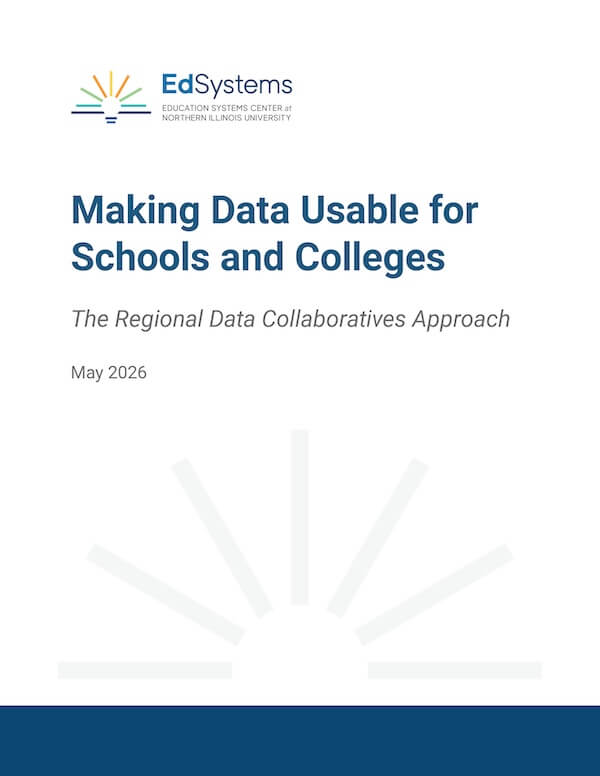
In our recently released brief, “Making Data Usable for Schools and Colleges: The Regional Data Collaboratives Approach,” we outline a pilot undertaken with a community college and two school districts in Illinois. We define a regional data collaborative as a partnership where school districts and higher education institutions co-develop shared research questions, then securely share and link longitudinal data from grade 9 through grade 14 and into the workforce.
To make this data actionable, we look at the work in two distinct parts: the engine and the chassis. Implementing the behind-the-scenes core processes for data management—such as establishing legal data agreements, secure cloud data loading, and cross-institutional linking—is the engine of a collaborative. But to drive real conversations, administrators need a chassis: analytic frameworks and investigative tools that turn complex raw numbers into meaningful insights.
Our new regional data approach provides communities with three distinct levels of investigative scaffolding, helping users move from simple questions to long-term trend analysis:
1. Visualizing Institutional Milestones and Access Gaps
A key tenet of our approach is that reporting must be immediately useful to the local entities sharing the data. Our frameworks help administrators look internally to see how student experiences—such as pathway participation, advising, or co-curriculars—impact milestones like earning dual credit. Well-designed data tools allow leaders to move beyond basic student body averages and actively investigate real concerns about equitable access by low-income status, race, or ethnicity.
2. The Cohort Framework
To reduce data confusion, our approach groups students into longitudinal cohorts based on their 9th-grade on-track status and early assessment scores. By monitoring students with similar academic profiles over time, school districts and community colleges can identify which specific experiences most effectively accelerate student progress. For example, community colleges can evaluate the retention rates of dual credit students based precisely on the type of course (CTE vs. non-CTE) they took in high school.
3. Scaffolding Toward Workforce Insights
The ultimate milestone for pathway success is helping students secure long-term employment with a livable wage. However, building a data infrastructure that seamlessly bridges local education data with workforce outcomes is a massive, complex undertaking—and it is the vital next step EdSystems is actively working to solve. To get there, our approach intentionally scaffolds investigative tools so local users can build their data capacity in manageable stages. School and college leaders start with simple, institutional questions—like tracking dual credit access among specific student cohorts. As regional partnerships mature, they graduate to complex cross-institutional tracking. By building this local capacity today, we are laying the structural groundwork necessary to eventually link regional data to long-term employment outcomes and workforce trends tomorrow.
Breaking Down Silos for Collective Learning
Existing state and federal resources, such as the Illinois High School 2 Career and Post-Secondary Employment Outcomes Explorer, already support pieces of this vital inquiry. However, maximizing these resources requires building a local organizational data culture that knows how to connect the pieces.
By adopting a community-of-practice framework that leans into learning science, school districts and colleges can finally partner transparently. EdSystems is now using this refined analytic approach to inform our regional pathways initiatives and build localized tools to support continuous improvement.
We invite you to read our new resources to explore the underlying data engine, and partner with us to build the data-informed processes your community needs to guide every student toward economic mobility.