In 2009, the Illinois P-20 Council adopted a statewide postsecondary attainment goal to ensure that 60 percent of adults hold a high-quality postsecondary credential by 2025 (i.e., the 60 by 25 goal). This goal was a key part of The Illinois Public Agenda for College and Career Success, recognizing the link between education and meeting the workforce needs of the future, and motivated policymakers and practitioners throughout the P-20 and workforce pipeline to develop policies and practices that prepare more adults for success. Currently, 57.1 percent of Illinois adults have a high-quality postsecondary college or career credential, according to the Lumina Foundation.
As we complete the target year, state leaders have not yet developed a new vision to illuminate how statewide and local leaders can work together to advance postsecondary attainment and economic mobility for Illinoisans, regardless of their background. Without a shared vision and a robust state-level ecosystem to advance goals across agencies and throughout the preschool-to-college (i.e., P-20) pipeline, we see frequent misalignment across secondary, postsecondary, and workforce systems. That structural misalignment is further exacerbated by underlying cultural and relational differences across those driving the system forward.
What Did Having a Goal Lead To?
Illinois’ 60 by 25 goal drove both state and local action throughout education and workforce systems.
At the state level, agencies integrated strategies into state education and workforce plans that improved progressions through the pipeline, such as in the higher education strategic plan, A Thriving Illinois, the Every Student Succeeds Act plan, career and technical education, and the Governor’s Commission on Workforce Equity and Access recommendations. These plans advance work to prepare learners for college and career, aligning education and training pathways to projected employment opportunities. The work went beyond the education sector and fostered alignment efforts across agencies, such as through the Workforce Readiness through Apprenticeships and Pathways committee of Governor Bruce Rauner’s Children’s Cabinet and the strategies outlined in Governor Pritzker’s Executive Order #3 Report. While cross-system coordination and alignment continue to be areas for improvement, the state’s postsecondary attainment goal required leaders to both individually and collectively work on improving systems.
Beyond this statewide work, there was a groundswell of local work to drive attainment, despite a lack of funding for communities to support the goal. Recognizing the emergence of local initiatives across Illinois to increase postsecondary attainment and the lack of statewide support infrastructure, the Illinois 60 by 25 Network was launched in 2013 by Advance Illinois, Education Systems Center (EdSystems) at Northern Illinois University, and the Illinois Student Assistance Commission (ISAC). In 2022, the collective updated its name to the Illinois Education and Career Success Network to express its purpose and vision for 2025 and beyond. In 2015, the network established Leadership Communities to recognize communities committed to using the organizing principles of collective impact to advance postsecondary attainment.
Lessons Learned and Limitations
Collective Action Drives Impact
Uniting across education and workforce provides structured opportunities for different actors to make a difference (both statewide through interagency collaboration and locally through community teams). The collective impact model in communities strengthens the work and increases the seamlessness of experiences for learners. For example, Leadership Communities were well-positioned to respond to crises like the pandemic because they had established strong relationships with partners. Specifically, while schools closed when the pandemic began, many businesses stayed open. To ensure that students still had work-based learning opportunities, one community implemented virtual career awareness panels, which were recorded and shared with teachers for ongoing use as a career awareness tool.
Innovation Thrives With Investment and Support
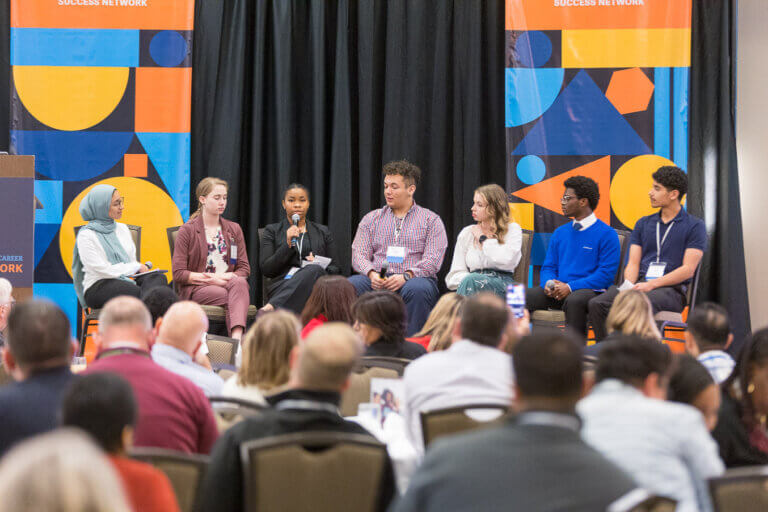
A core tenet of the Success Network has been to focus on opportunities for learning and sharing across communities. Network Organizers have provided an annual conference, targeted technical assistance, and connected communities directly to foster peer-to-peer learning. Communities indicate that having a platform to raise challenges they are grappling with, learn from other participants, and amplify their own learnings helps advance their work.
Network Organizers have provided innovation grants to Leadership Communities to support the implementation of key state policy initiatives. This grant model enables the seeding of local implementation efforts and thus builds proof points for broader scaling of state policy across Illinois. The relatively small but flexible investments have had a tremendous impact on many Leadership Communities’ ability to catalyze efforts that otherwise may not have been possible.
Quality Data Drives Goal-Setting, Action, and Continuous Improvement
Access to actionable data helps identify areas for action. For example, the fact that Illinois’ attainment rate was below 60 percent, while labor market data showed that Illinois needed more people with postsecondary credentials, spurred action. At the local level, the Success Network dashboard helps Leadership Communities and all regions across Illinois better understand learners’ experiences in pursuing postsecondary credentials and has spurred actions such as revising placement policies, etc., to drive more students into preparation strategies.
Sustaining Collaborative Work Is Challenging, but the “Right” Kind of Hard
Staffing turnover and limited funding for intermediaries, the organizations that bridge efforts across entities within communities, and across state partners, can deter continuity and impact. Leadership Communities are encouraged to identify more than one intermediary to address capacity issues by sharing responsibilities across organizations.
Gaps Persist
While Illinois has made progress in several areas, e.g., the percent of students taking CTE classes across the state has returned to pre-pandemic levels, and both the number of districts and students earning a college and career pathway endorsement doubled in SY24, there are persistent gaps for students from low-income households, students of color, English Learners, and students with disabilities.
What Should Happen Next
As Illinois’ economy continues to diversify and its economic prospects improve as a result of recent developments in nascent industries such as quantum computing, clean energy, and artificial intelligence, it is even more important that Illinois’ public institutions organize around a collective vision of how public systems and resources, coupled with private sector investments and opportunities, can provide true economic mobility for all Illinois residents.
Such a goal will require two key strategies:
1. Building a Table of Champions
An inclusive vision should galvanize all sectors of Illinois’ education, workforce development, and economic development systems to see their place in providing economic mobility for all Illinoisans. Centering economic mobility can pressure our education and workforce systems to improve how learners are prepared for the jobs of tomorrow, and can drive employers to improve job quality. To ensure this goal can be achieved, the state should cultivate a table of statewide and local champions who can hold the vision and monitor and identify strategies to drive toward this vision throughout the P-20 and workforce pipeline.
2. Invest in Data
The state should invest in robust data systems and integration to ground both initial goal-setting and continuous improvement. State and local leaders need access to quality, longitudinal data to target and operationalize strategies that improve progressions through education to employment, and to evaluate where policy and programmatic interventions are generating the most impact. As federal data infrastructure and resources continue to weaken, this is even more essential to shore up at the state level.